Sheet 09 · Reference
Resources
Drawings and data sheets, answers to common questions and a glossary.
01Downloads
- PDFTypical freezer floor construction, stepped cutaway35 KB
- PDFFFCH freezer floor monitor and control data sheet540 KB
- PDFHydronic (glycol) system operation96 KB
- PDFRamp and threshold heating mat data168 KB
- WEBGuide specification—
- REPLayout and circuit zoning calculator—
02Representative resources
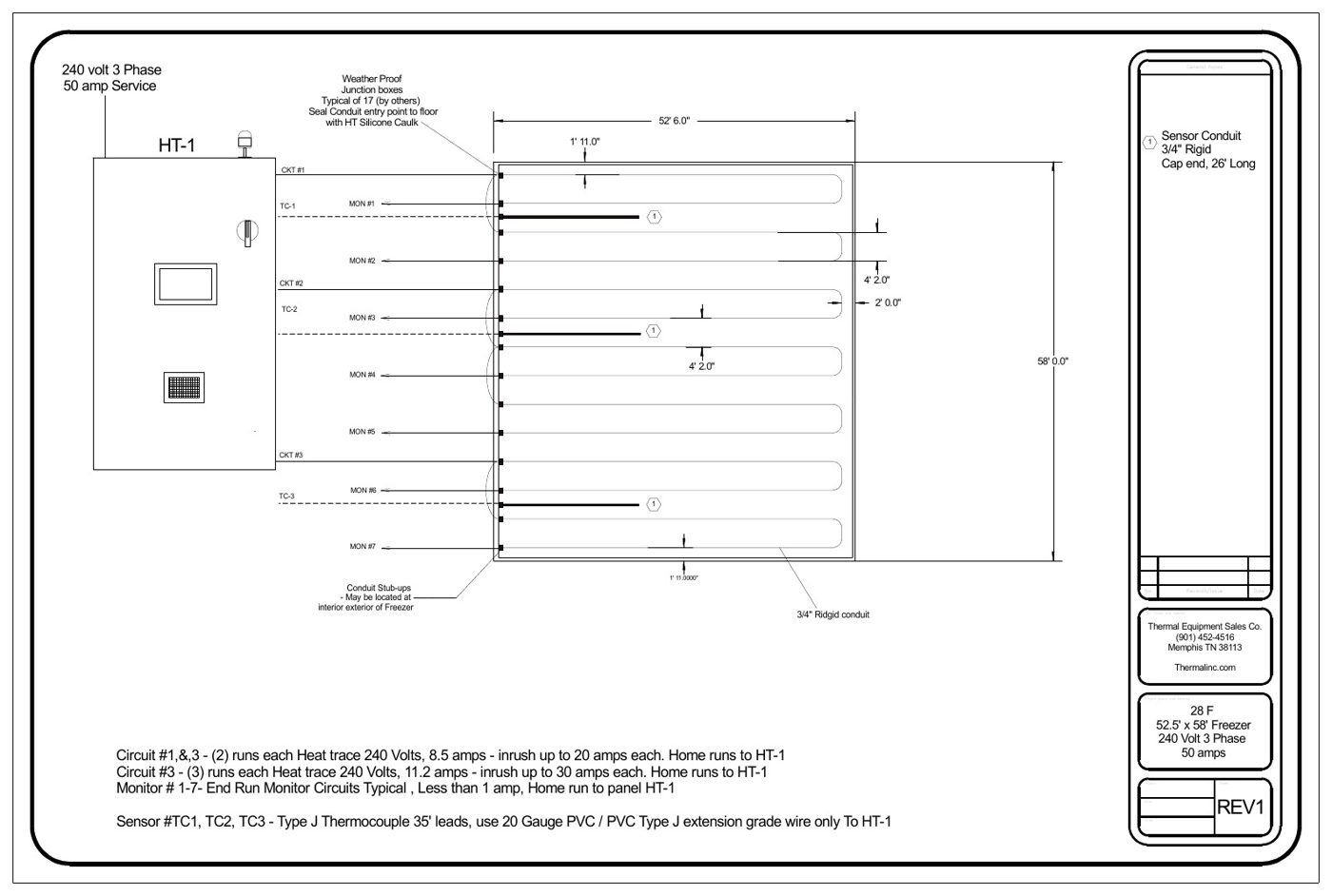
Representatives have tools for preliminary project work, including the layout and circuit zoning calculator. It lays out the conduit loops, groups them into zones by breaker size, places a sensor in each zone and estimates the heat load.
Questions? Call (901) 452-4516.
03Frequently asked questions
Does floor insulation alone prevent frost heave?
No. Insulation slows the flow of heat from the ground into the freezer but does not stop it. With no heat added below, the ground under a long-running freezer keeps cooling until the soil freezes. Insulation delays frost heave; it does not prevent it.
Which rooms need frost heave protection?
Rooms held below 32 °F on a slab on grade: freezers, blast freezers, cold storage warehouses and ice rinks. Coolers held above freezing usually do not need it, though large rooms near 32 °F should be reviewed.
How long does frost heave take to appear?
Usually one to several years after the freezer starts, depending on room temperature, insulation, soil type, groundwater and floor size. By the time movement is visible, a large volume of ground is usually frozen.
Why is the heat cable installed in conduit?
Conduit protects the cable during construction and allows it to be pulled in after the slab is poured. If a cable is ever damaged, it can be pulled out from the junction box and replaced without cutting the floor.
Why self-regulating cable?
Its output increases as it gets colder and decreases as it warms, along its entire length. The coldest ground receives the most heat, and the cable cannot overheat itself in the base.
What temperature is the ground held at?
The setpoint is adjustable at the panel and cannot be set below 32 °F. It is chosen to keep a margin above freezing in the base between the heating legs.
How is a failed cable detected?
Each circuit has far-end voltage sensing and each cable run has an end-of-run relay. Loss of voltage or continuity on a call for heat raises an alarm that identifies the circuit or run. Ground temperature is monitored separately as an independent check.
Can the system connect to a building management system?
Yes. The panel provides dry alarm contacts or a 24 VDC alarm output, and Ethernet with Modbus is available.
How do I estimate operating cost?
Multiply the design load in kW by the hours per year the controller calls for heat and by the utility rate. The design load for a typical floor is roughly 0.5 to 2 W per square foot of floor; actual run time depends on the setpoint and the floor, and peak setback can shift use away from demand periods.
Who installs the system?
The electrical contractor installs the conduit, cable and wiring from our layout and electrical details. We supply the control panel, heat cable and accessories, instructions and checkout form, and provide phone support during installation and startup.
Can an existing freezer floor be protected?
If a floor shows cold spots or early movement, heaters can be installed into the base from above at the problem area by drilling through the slab and insulation. This works best on small areas and each floor must be evaluated.
04Glossary
- Frost heave
- Upward movement of the ground and anything on it caused by ice forming in the soil.
- Ice lens
- A layer of clear ice that grows in frost-susceptible soil as water migrates to the freezing front.
- Frost-susceptible soil
- Soil with enough fine particles, usually silts and lean clays, to draw water to a freezing front by capillary action.
- Heated base
- The mud slab or aggregate layer below the insulation where the heating conduit is placed.
- Hairpin loop
- A conduit made of two parallel legs joined by a sweep at the far wall, with both ends at the same wall.
- Leg
- One straight run of conduit across the floor. Two legs make a loop.
- Run
- One continuous length of heat cable in one loop, from power connection to end seal.
- Circuit
- One or more runs fed from one breaker and switched by one solid-state relay.
- Zone
- An area of floor controlled from one temperature sensor.
- Self-regulating cable
- Heat cable with a conductive polymer core whose output falls as its temperature rises.
- SSR
- Solid-state relay. Switches a heating circuit with no moving contacts.
- GFEP
- Ground-fault protection of equipment. Trips a heating circuit on ground leakage current, typically 30 mA.
- End-of-run relay
- A relay at the far end of a cable run that proves the run is continuous and energized.
- Far-end voltage sensing
- Measurement of voltage at the end of a circuit to confirm the relay, breaker and cable are passing power.
- Peak setback
- Lowering the setpoint during utility peak-demand periods through a remote input.
- Inrush
- The high current a self-regulating cable draws when energized cold, before its output settles.