Sheet 01 · Background
What causes frost heave under a freezer floor
Frost heave is the upward movement of a slab caused by ice forming in the soil below it. Under a freezer the cause is steady: the room is a heat sink that never shuts off.
01Heat flow through an insulated slab
Heat moves from the warmer ground up through the base, insulation and slab into the room. For a slab-on-grade the rate per square foot is roughly
q = ΔT ÷ Rtotal [Btu/h·ft²]
where ΔT is the difference between the ground and room temperatures and Rtotal is the combined thermal resistance of the insulation, slab and surface films.
Worked example
A 10,000 ft² freezer at −10 °F sits on ground that starts at 50 °F. With 6 in. of foam insulation at about R-5 per inch, plus the slab, Rtotal is about R-31.
- q = 60 ÷ 31 ≈ 1.9 Btu/h·ft² (≈ 0.57 W/ft²)
- Q = 1.9 × 10,000 ≈ 19,000 Btu/h, or about 5.7 kW, drawn out of the ground around the clock
Natural heat flow up from deep in the earth is on the order of 0.006 W/ft², about one percent of that loss. The ground cannot resupply the heat, so its temperature falls year after year until the soil freezes.
The example is for understanding only. The design tables on the System Design sheet add allowance for edge losses, cable spacing, derating in conduit and a safety margin.
Doubling the insulation halves the heat loss, and roughly doubles the time before the ground freezes. It delays the outcome; it does not change it.
02Three conditions for frost heave
Damaging heave needs all three of these at the same time:
| Condition | Under a freezer |
|---|---|
| Freezing temperature in the soil | Supplied by the room itself, all year. Insulation only delays it. |
| Frost-susceptible soil | Silts, silty sands and lean clays are the most susceptible. Their fine pores pull water toward the freezing front by capillary action. Clean sand and gravel are much less susceptible. |
| A supply of water | A water table, perched groundwater, poor site drainage or wet fill. The soil does not need to be saturated when the building is new; water keeps migrating to the cold zone. |
Water expands about 9 % when it freezes, but that alone would cause little movement. Heave comes mostly from ice lenses. As the freezing front stalls at a depth, water moves up to it and freezes in growing horizontal layers of clear ice. Stacked lenses can add inches or feet to the soil thickness.
Removing one condition helps but is hard to guarantee over the life of a building. Non-frost-susceptible fill and good drainage lower the risk. Keeping the soil above freezing removes the cause.
03Why the damage shows up years later
A new freezer sits on warm ground that has a large store of heat. The insulation slows the loss, so it can take one to several years, depending on room temperature, insulation, soil and building size, before the 32 °F line reaches the soil. By then there is a large mass of cold ground, and ice lenses keep growing even if the problem is caught.
Large floors are at the most risk in the center. Near the walls, heat from outside the building reaches the soil. The middle of a large freezer gets no such help, which is why heave usually shows as a hump away from the walls and why sensors are placed toward the center.
Common symptoms
- Cracks radiating from the center of the floor, or a raised area you can see with a straightedge or laser level
- Doors that drag, bind or no longer seal
- Rack columns and walls out of plumb, damaged wall panels at the floor line
- Frost or ice at slab joints and the floor–wall junction
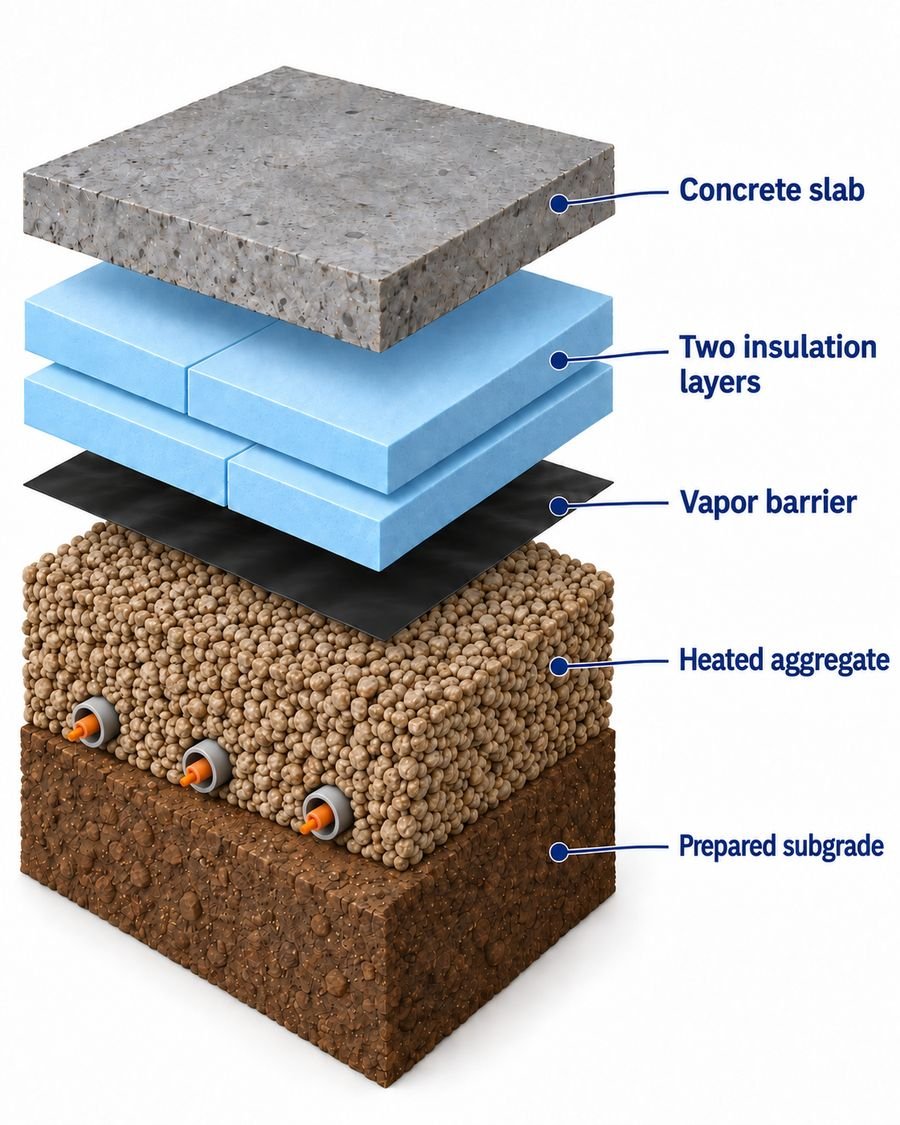
04Ways to prevent it
| Method | How it works | Notes |
|---|---|---|
| Electric heat cable | Self-regulating or constant-wattage cable in conduit in the base, switched by a controller. | No fluids or moving parts in the floor. Each circuit can be measured and alarmed. Design details |
| Hydronic (glycol) | Warm glycol pumped through plastic tubing in the base. | Can use waste heat from the refrigeration system. Needs pump, heater, manifold and fluid maintenance. Comparison |
| Ventilated base | Pipes or ducts in the base carry outside or building air, naturally or with fans. | Depends on the air being warmer than freezing. Not suited to cold climates without heated air. |
| Elevated floor | The freezer floor is built above a ventilated crawl space. | Separates the floor from the soil. High structural cost; common only in special cases. |
05Existing freezers
Floors built with no subfloor heat, or where a glycol or air system has failed, can develop cold spots. When monitoring or a survey finds soil approaching freezing in a limited area, heaters can be installed from above by drilling through the slab and insulation and lowering heaters into the base at the trouble spot. This reclaim approach works best on small areas and must be evaluated for each floor, including the structural effect of the penetrations. Contact us with the floor history and any temperature data.